We recently met the management of Sun TV. The key takeaways from the meeting are:
Ad revenues: Although the outlook on advertisement revenues is challenging, the company expects to increase ad revenues by increasing inventory utilization (current inventory utilization level is ~50-55%). However it believes that ad rate hikes are unlikely. Sun TV had increased rates by ~10% in Feb, 2008. Broadcast fee rates depend strongly on the ad-spends scenario. FMCG (55%) is the highest contributor of advertisement revenues for Sun TV. The ad mix in terms of Regional:National is ~30:70. This has protected Sun TV as both FMCG and regional advertisers continue to remain buoyant.
DTH subscribers: Sun TV had ~3.3 mn DTH subscribers as of Dec 08. This is expected to increase to 3.8 mn by end of March ‘09. Its ARPU from DTH subscribers is INR 26 per month currently. Company expects significant ramp up in DTH subscribers and revenues in FY10.
Analogue revenues: Sun TV expects to increase it analogue subscription revenues by 15-20% in FY10.
International revenues: The company is receiving overseas revenues from Malaysia, Singapore, Canada, Sri Lanka, and UK. In the US the company is present only in the DTH distribution network, and soon expects to be carried by other digital and analog carriers also. It expects 10-15% incremental revenues from this stream. Currently Sun TV’s forex exposure is only in USD and it has benefitted from the recent appreciation of the currency.
Competition: Kalaignar TV's market share is much below compared to Sun TV (Tamil GEC). However, according to our industry checks Kalaignar TV has been able to boost its presence strongly with programming of comparable quality, which could turn out to be a potential threat for Sun TV. In the presence of these two channels others players have been further marginalized in a market which was already dominated by Sun TV.
Movie production: In the movie production business Sun TV would be closing FY09 with 6 movies, all under INR 50 mn cost of production. Out of these 6 movies, it is currently carrying 5 movies on its balance sheet - under intangibles - which will be written off after 1st broadcast. In FY10 the company plans to invest INR 500 - 700 mn in the business, producing 8-10 movies with an average return expectation of 20-25%.
Radio: In the radio business, the company expects a topline of INR 300 mn and a loss of INR 600 mn in FY09. For FY10, the company expects to reduce net loss to INR 400 – 450 mn on a topline of INR 400 mn. It is also expecting to break-even in FY11. All the stations together will be fully operational for the first time in FY10. It has been constantly cutting down on redundant expenses in the business.
Capex: On broader financial aspects – Sun TV doesn’t expect any significant surprises on the operating costs front. Cap-ex planned for FY10 is ~INR 2.5 bn (INR 1 bn for enhancing its movie library, INR 400 mn for broadcasting business, INR 100 mn for the radio business and INR 1 bn for office premises).
Wednesday, March 18, 2009

Sunday, November 16, 2008
Indian Pay-revenue Model
Here is how Indian DTH Market is expected to perform in the next 2 years.
We estimate content costs are ~55% of subscription revenues and are expected to decline to ~45% of revenues as the “sliding scale” mechanism kicks in.
- No of DTH Homes at end of FY2009 - 8.1 mn which is 10% of Cable Market with an ARPU of Rs 180. Overall size of the DTH market is Rs 13,100 cr.
- The Number of DTH Homes by FY12 is expected to be 21 mn which is likely to be 21% of Cable market and have an ARPU of Rs 208
We estimate content costs are ~55% of subscription revenues and are expected to decline to ~45% of revenues as the “sliding scale” mechanism kicks in.
Tuesday, November 11, 2008
Ramp-up Plans of DTH Players
In the next few posts we are going to cover about DTH market in India along with TV broadcasting and content market with some amazing statistics that will be unveiled for the first time.
Today we are going to tell you about the business plans of various DTH service providers.
Today we are going to tell you about the business plans of various DTH service providers.
- Dish TV [Zee Group Company] Has a customerb ase of 4.4mn is the largest and oldest operator in the DTH business in India
- DD Direct - DTH arm of Doordarshan has 3.5 mn subscribers. Most likely to end up with the same fate as BSNL in Mobile Subscribers [Initial Lead and will fall later]
- Tata Sky - Looking at a minimum of 8m connections by FY12 from the current 2m subscribers in direct-to-home (DTH) space
- Sun Direct - Sun Direct announced 1m DTH subscribers in 200 days - only from the four Southern states. The company is targeting 3m subs by year end
- Reliance Big TV - Big TV announced on Oct 20 that it had reached 0.5m subscribers within 2 months of launch. It plans to add ~0.4m subscribers every month with an on ground infrastructure spanning 6,500 towns. The company is targeting 5m subscribers within the first year of operations
- Bharti Airtel Digital TV - Recently launched. Digital TV will be initially available in 62 cities across the country through 21,000 retail points (including Airtel relationship centres). According to press articles, the company aims to capture 20% of the net additions of DTH subscribers this year
Wednesday, October 15, 2008
Tata Sky Video Recorder Unveiled
India's largest DTH Platform - Tata Sky just a while ago unveiled a Personal Video Recorder - PVR Hardware to its customers. Using PVR, customers can record upto 45 hours of video which can be viewed any time they wish to. PVR functions exactly liek your VHS / DVD Player for the content stored on the 160GB hardDisk. PVR will cost you an additiona Rs 9,000.
The best feture of this is, you can watch one channel and record on the other channel. So no more fighting with your spouse as one of you can get into the recording mode and let the other watch in peace :-) Like many hardworking and knowledgable Indian familes who work extended hours, you can program your PVR to record 2 channels simaltenously if the TV is not ON.
Service will be made available in 12 Tier-I Indian cities first and then rolled out on PAN India basis. This leaves Reliance Big TV DTH and Airtel Digital TV behind in the race :-)
The best feture of this is, you can watch one channel and record on the other channel. So no more fighting with your spouse as one of you can get into the recording mode and let the other watch in peace :-) Like many hardworking and knowledgable Indian familes who work extended hours, you can program your PVR to record 2 channels simaltenously if the TV is not ON.
Service will be made available in 12 Tier-I Indian cities first and then rolled out on PAN India basis. This leaves Reliance Big TV DTH and Airtel Digital TV behind in the race :-)
Wednesday, September 10, 2008
Dish TV - Tata Sky - Big TV- Bharti Telmedia
The following chart shows comparison of the top 4 Diredt to Home [DTH] SErvice Providers in India on various parameters.
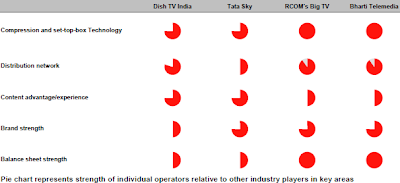
Technology: The MPEG-4 compression technology used by Sun Astro and RCOM and to be used by Bharti is more advanced than the MPEG-2 compression technology currently being used by incumbent players Dish TV India and Tata Sky. RCOM and Bharti would also benefit from the synergies with existing technology and billing platforms and service support systems in their telecom business.
Distribution network: Dish TV has a decent but fast-growing distribution network. For the quarter ending 30 June 2008, Dish had 38,000 dealers covering 4,500 towns. Bharti and RCom will leverage on existing wireless distribution network.
Content advantage/experience: Dish TV scores above the competition on this metric. We expect Dish TV to benefit from its parent company Zee's long and strong pedigree in content generation.
Brand strength: We note that Tata Sky has built a strong brand image due to its heavy promotional activity in the past year. Bharti and RCOM are established pan-India wireless players and their execution track records imply impressive DTH service roll-outs, in our view.

Technology: The MPEG-4 compression technology used by Sun Astro and RCOM and to be used by Bharti is more advanced than the MPEG-2 compression technology currently being used by incumbent players Dish TV India and Tata Sky. RCOM and Bharti would also benefit from the synergies with existing technology and billing platforms and service support systems in their telecom business.
Distribution network: Dish TV has a decent but fast-growing distribution network. For the quarter ending 30 June 2008, Dish had 38,000 dealers covering 4,500 towns. Bharti and RCom will leverage on existing wireless distribution network.
Content advantage/experience: Dish TV scores above the competition on this metric. We expect Dish TV to benefit from its parent company Zee's long and strong pedigree in content generation.
Brand strength: We note that Tata Sky has built a strong brand image due to its heavy promotional activity in the past year. Bharti and RCOM are established pan-India wireless players and their execution track records imply impressive DTH service roll-outs, in our view.
Subscribe to:
Posts (Atom)